
Next.js vs WordPress for Business:
Which One Wins in 2026?
Author
Carlos Beuvrin
Published
Jun 2026
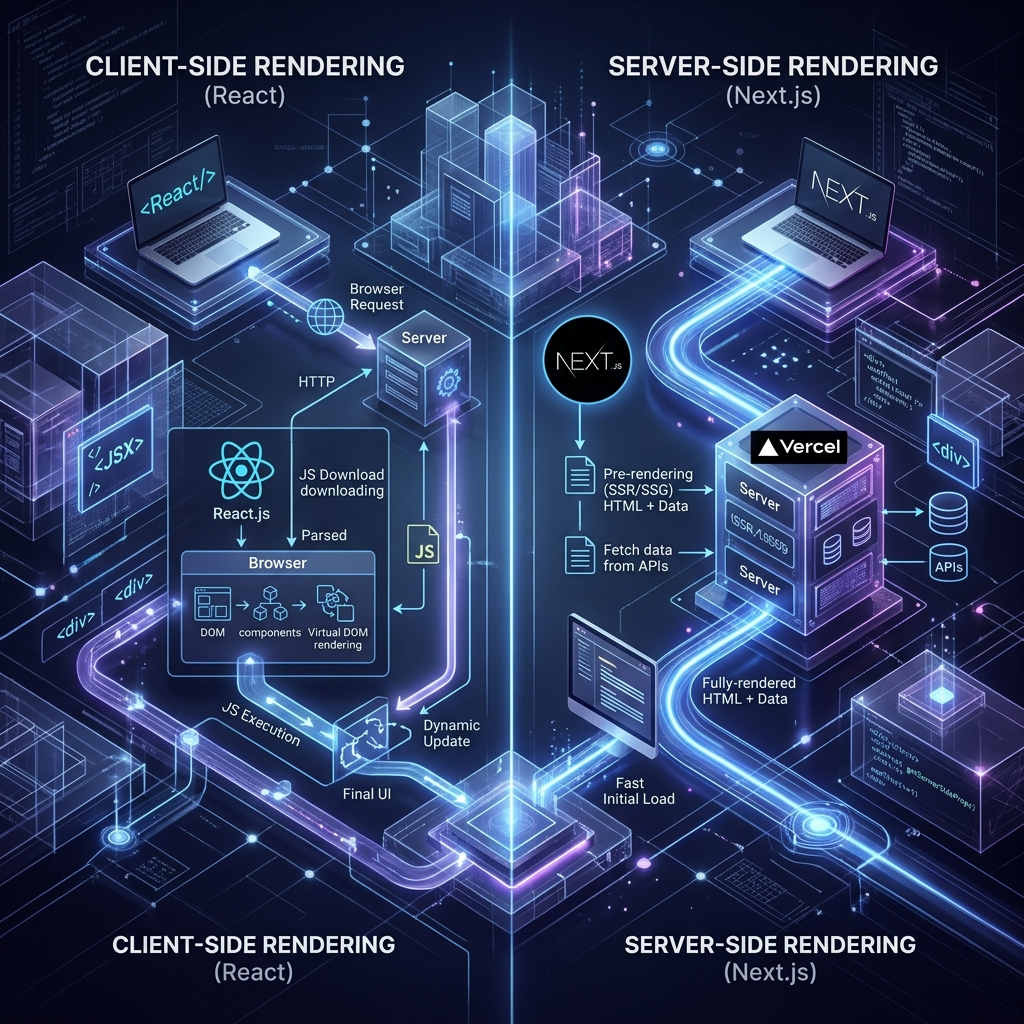
Next.js or WordPress? Short answer: choose WordPress if you need a blog or a content site that non-technical people can manage, on a tight budget, launched fast. Choose Next.js if your site or app is core to the business and you need performance, custom integrations, security, and room to scale. It's not about which one is "better" — it's about which one fits your project.
What each one actually is
WordPress is a content management system (CMS) that powers a huge share of the web. It works through themes and plugins: you assemble the site from prebuilt pieces. Its strength is publishing and editing content without touching code.
Next.js is a development framework (built on React) for building custom sites and applications. You don't start from templates: you build exactly what your product needs, with server-side rendering for speed and SEO.
Head-to-head comparison
- Performance and speed: advantage Next.js. Server-side rendering (SSR/SSG) and the absence of heavy plugins translate into better Core Web Vitals — critical for Google and for conversion.
- Security: advantage Next.js. WordPress carries a large attack surface because of its third-party plugin ecosystem; a custom-built site exposes far less.
- Scalability: advantage Next.js as the project grows (heavy traffic, business logic, private areas). WordPress can scale, but it usually needs more patching along the way.
- Flexibility / customization: advantage Next.js. You can build any experience or integration without theme limitations.
- Content editing: advantage WordPress. Its visual editor lets anyone publish; with Next.js you need to wire up a headless CMS to get something similar.
- Upfront cost and time: advantage WordPress — cheaper and faster to launch. Next.js means more upfront investment, but less technical debt down the road.
- SEO: roughly a technical tie (both can rank well), with Next.js having the edge in full control over performance and structure.
When to choose WordPress
- Your site is mainly a blog or content publication.
- You need your team to publish and edit without depending on developers.
- Budget and time-to-launch are the priority.
- You don't need complex functionality or custom integrations.
When to choose Next.js
- Your website or app is central to the business (e-commerce, platform, SaaS).
- You need real performance, integrations (payments, CRM, ERP, AI), or private areas.
- You want a unique experience, not a recognizable template.
- You're looking for security, scalability, and a product that grows with you without a rebuild a year in.
The verdict for businesses
For a blog or a simple informational site, WordPress is still a valid, affordable choice. But for businesses whose digital product is strategic — where speed, security, integrations, and differentiation matter — Next.js is the stronger medium-term bet: it costs more up front, but it avoids the technical debt and the "rebuild everything" moment that comes with growth. For the year-by-year costs of WordPress with Elementor, plus speed and security data, see WordPress vs React in 2026: is Elementor still worth it?
How to decide
The right call depends on the role your site plays in the business, not on what's trendy. At Keting Media we design and build custom software, websites, and apps with Next.js, React, and applied AI — and we'll also tell you honestly when a template is all you actually need. Working with a nearshore team in Mexico City means that conversation, and everything after it, happens in your own time zone. Tell us about your project and we'll recommend the right path, without overselling.